

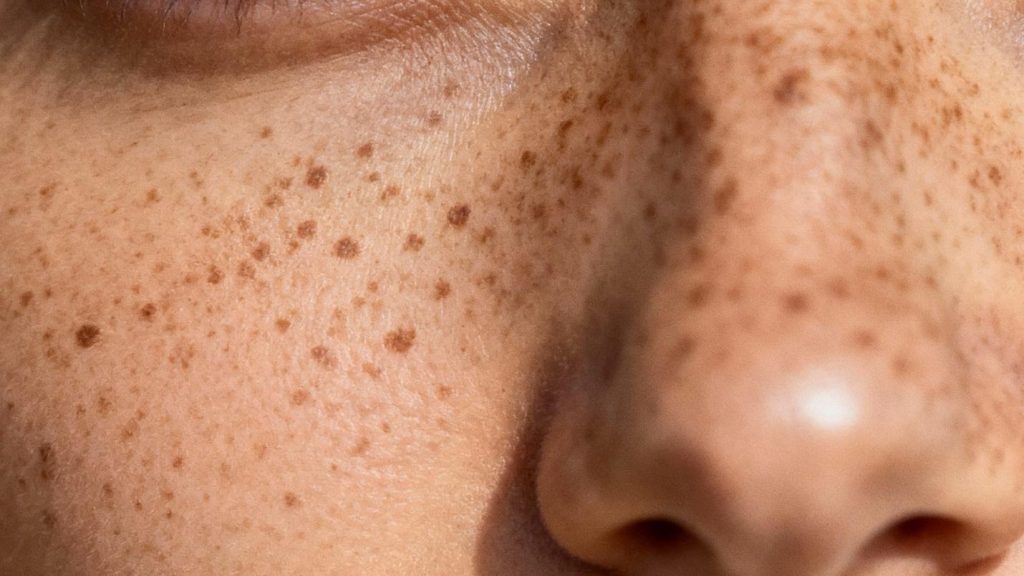
“Doctor, these are just freckles… right?”
That is probably one of the most common things I hear when patients point to the pigmented spots across their cheekbones.
And to be fair, it does look that way.
They are small. They sit in similar areas. Sometimes they even appear gradually over time. So it feels natural to group them all under the same label.
But quite often, when we take a closer look, they are not freckles at all.
They can be what we would call “Hori’s naevus”.
And while the difference may seem subtle on the surface, it matters a lot when it comes to how we treat it.
Let’s start with freckles.
Most people are somewhat familiar with them.
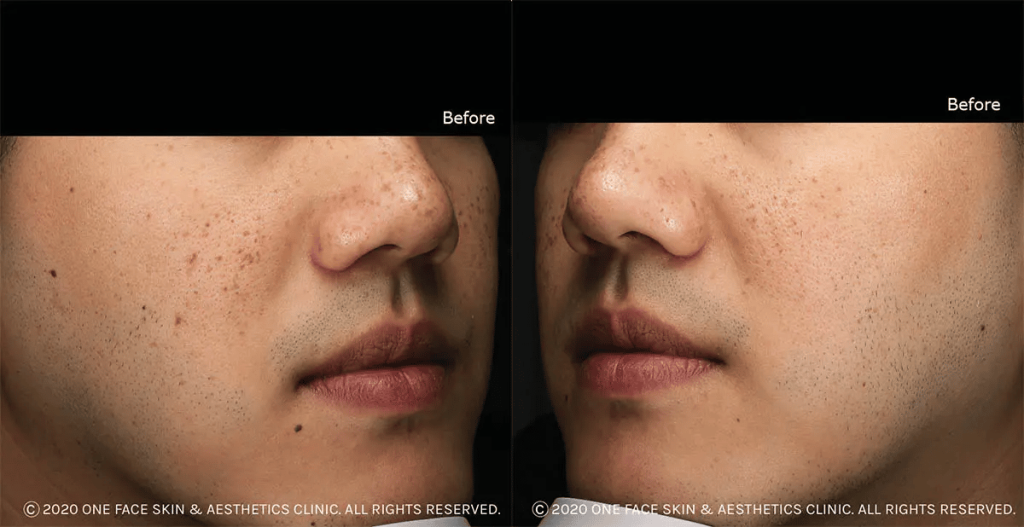
They usually show up as tiny brown dots scattered across the cheeks and nose. Some patients describe them as:
“It looks like someone flicked little specks of pepper across my face.”
That is actually a very good description.
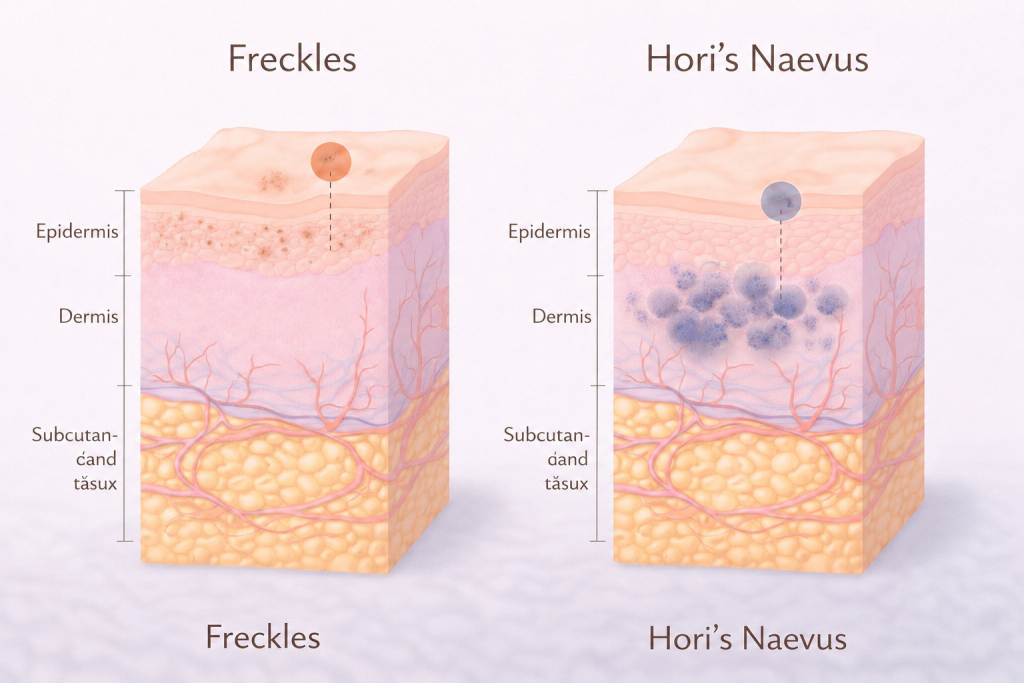
Freckles tend to sit quite close to the surface of the skin, within the outer layer. Because of that, they behave in a way that feels quite predictable.
Spend more time in the sun? They darken.
Stay out of the sun? They may lighten a little [1].
They are also more commonly noticed at a younger age.
So if someone tells me, “I have had these since I was a teenager, and they come and go depending on sun exposure,” freckles are usually high on the list.
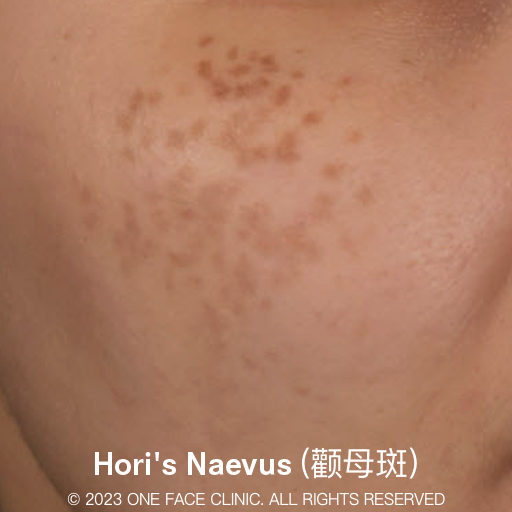
Now compare that to another scenario.
A patient in their 30s or 40s comes in and says:
“These spots were not here before. They just started appearing over the past few years… and they are not fading.”
When I hear that, I start thinking less about freckles and more about Hori’s naevus.
Hori’s naevus is a form of deeper pigmentation in the skin that tends to look slightly different once you know what to look for:
And most importantly, it does not behave like freckles.
It does not fade easily. It does not fluctuate much with sun exposure. It tends to persist.
That is usually the clue.
Honestly, it is an easy mistake to make.
Both freckles and Hori’s naevus:
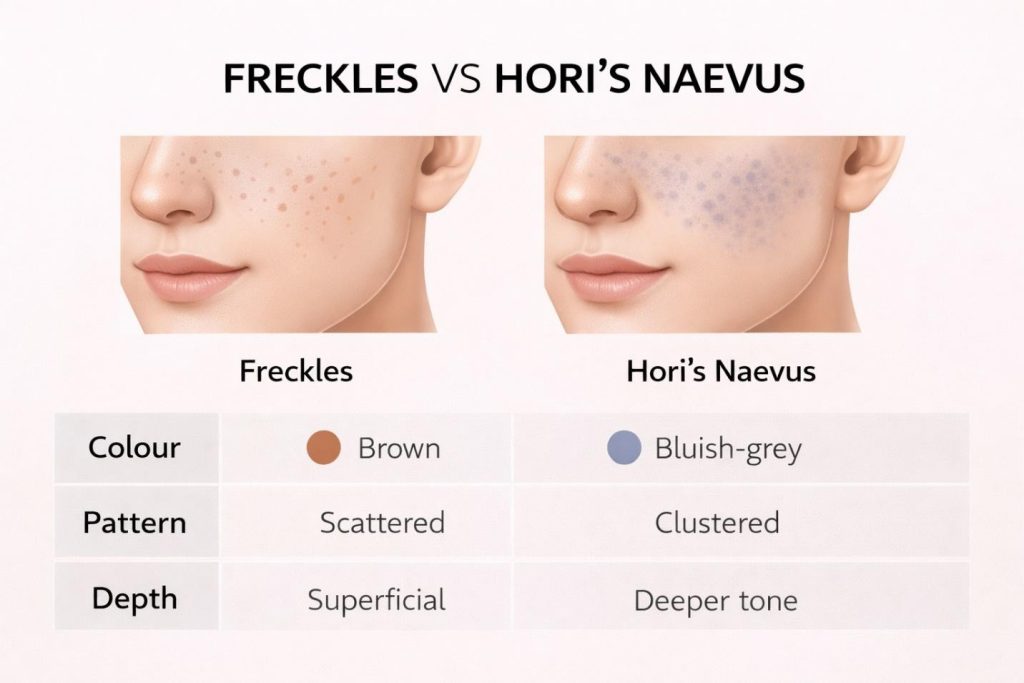
If you are just looking in the mirror, there is no obvious reason to think they are different. But from a medical point of view, one key difference changes everything: Depth.
Freckles sit near the surface.
Hori’s naevus sits deeper in the skin.
And that one detail is what determines how your skin will respond to treatment.
This is where many patients start to feel frustrated.
They try creams. Maybe even a few laser sessions. But the spots do not seem to change.
I have had patients say:
“I spent months treating this as freckles… but nothing worked.”
And often, the issue is not that treatment failed.
It’s that we were treating the wrong thing!
Surface-level treatments [2] can work quite well for freckles. But if the pigment is sitting deeper [3], like in Hori’s naevus, those treatments may not reach it at all.
So from the patient’s perspective, it feels like:
But in reality, it is just a mismatch between the condition and the treatment.
When someone comes in unsure about their pigmentation, I don’t rush straight into treatment.
Instead, we take a step back and ask a few simple questions.
When did it start?
Has it changed over time?
Does it get darker with sun exposure?
And then we look closely at the skin itself.
Because once we understand whether the pigment is superficial or deeper, the treatment pathway becomes much clearer.
And more importantly, more effective.
If you take one thing away from this, it is this.
Not all spots are created equal.
2 given brown spots can look almost identical in the mirror, but behave completely differently depending on where the pigment sits in the skin.
And that is why some treatments seem to work very quickly, while others feel like they are going nowhere.
It is not always about doing more. Sometimes, it is just about doing the right thing for the right condition.

Freckles and Hori’s naevus can look very similar at first glance.
But once you understand the difference, the whole picture starts to make more sense.
If you have pigmentation spots or patches that are not responding the way you expected, or you are not quite sure what you are dealing with, it may be worth having it properly assessed.
In many cases, that small shift in understanding is what finally moves things forward.
Yes, Hori’s naevus is relatively common among Asian individuals, particularly in women, which makes it more frequently seen in Singapore.
Freckles usually appear as small, light brown spots that are scattered and well-defined, while Hori’s naevus tends to look more clustered with a bluish-grey tone. However, proper diagnosis often requires a clinical assessment by an experienced doctor.
Because the pigment is located deeper in the skin, light scatters differently, giving Hori’s naevus its characteristic bluish-grey appearance.
Multiple sessions (about 6-10x) are usually required, as deeper pigmentation (eg. Hori’s naevus) takes longer to respond compared to superficial pigmentation (eg. freckles).
Improvement can be for long, but maintenance may still be needed. Some recurrence can occur depending on individual skin types and triggers.
In some cases, both can be treated, but the approach may differ. A proper assessment is needed to determine the safest and most effective treatment plan.
Sunscreen helps reduce the darkening of freckles and may prevent them from becoming more prominent. While it does not remove Hori’s naevus, it helps prevent overall pigmentation from worsening.
No, freckles and Hori’s naevus are different conditions. Freckles do not transform into Hori’s naevus, or vice versa, as they originate at different depths within the skin.
Yes, frequent sun exposure in Singapore can make freckles appear darker and more prominent over time, especially without consistent sunscreen use.
Freckles are generally harmless and may not require treatment unless for cosmetic reasons. Some individuals choose to lighten them for a more even skin tone.
If pigmentation is persistent, changing, or not responding to skincare, it is advisable to seek a professional assessment to determine the exact type and appropriate treatment.
Feeling discouraged by melasma treatment? Learn why some patients struggle to see results, common treatment mistakes and why melasma can still be managed effectively with the right approach.
Read MoreThere's a famous story that Queen Cleopatra supposedly bathed in goat's milk to maintain her beautiful complexion. Whether that happened exactly as history tells it, we'll probably never know. But what it does show is that people have been experimenting with skincare at home for thousands of years. And thinking about it, not much has […]
Read MoreOne legit concern I hear often during consultations has nothing to do with the pigmentation itself. It's the cost of treatment. Sometimes, before we even start discussing treatment, patients will ask: "Doctor, be honest with me... am I about to spend a fortune treating this?" I totally understand where that concern comes from. Many people […]
Read More